Calvary Cemetery in Glenmont is home to numerous Civil War veterans. Many of the inscriptions on the veteran's gravestones are difficult to read due to the accumulation of biological growth and industrial pollutants.
On Friday, 22 May 2020, 10 AM - 2 PM, St. Agnes Cemetery Historian Kelly Grimaldi will show volunteers how to properly clean the gravestones. D2 Biological Solution, water, and nylon brushes will be available to use for this task.
For more information and to sign up please contact Kelly at 518.350.7679 or Kelly@ADCemeteries.org.
Calvary Cemetery
481 Route 9W
Glenmont, NY 12077
Showing posts with label gravestone cleaning. Show all posts
Showing posts with label gravestone cleaning. Show all posts
23 February 2020

13 April 2019
Upcoming Gravestone Restoration & Dutch Genealogy Programs
Again, time flies, how is it that I have not posted in three weeks? Life, family, work, research, and client work take preference. Now that
the weather is getting warmer work began at the Evangelical Protestant
Cemetery. Seven stones were either up righted or re leveled this past week. We
hope this progress can continue. On site and online research plus answering
many queries are keeping me busy also.
In May and June, I will give three presentations, locally. One, on basic gravestone restoration. Two, on the restoration of the
van Rensselaer family burial grounds in East Greenbush. Three, researching your
Dutch ancestors from home. Details for these presentations are below.
Gravestone
Cleaning and Restoration
Have you ever seen that unreadable gravestone or that
toppled monument and wondered “what can I do to address its condition?” There
is a correct way and a wrong way to remedy that gravestone. The program will
detail gravestone conservation including cleaning, repair, what to do, what NOT
to do, when to do nothing, and when to seek the help of a professional
conservator.
Thursday, 16 May 2019, 7:30 pm
at the Mynderse-Frederick House
451 Route 146, Guilderland Center
518.861.8582
Restoration of the
van Rensselaer Family Burial Ground in East Greenbush
A concise flash presentation on the efforts to restore
the early nineteenth century burial grounds of the van Rensselaer family in
East Greenbush. Numerous before and after photos will document the process.
This talk is one part of the New Netherland Family History Day hosted by the
New Netherland Institute. The event will feature consultations with
professional genealogists and talks on using records from New Netherland for your
research. The event will be held in the building that houses the New York State
Museum.
Thursday, 30 May 2019, time TBA
Cultural Education Center
222 Madison Avenue, Albany
518.486.4815
Online Dutch Research
from Home
The Netherlands have outstanding genealogical records. Best
of all; many of them can be found online and not through FamilySearch. Learn
basic methodology to begin searching for your Dutch ancestors. Discover the numerous online archives from the
various provinces in the Netherlands and see the actual Civil Registration
records and also Church Book records.
Saturday, 08 June 2019, 2 pm
2228 Western Avenue, Guilderland
518.456.2400
17 January 2019
Upcoming Presentation : Gravestone Restoration
On Thursday May 16, 2019 at 7:30 PM at the Mynderese-Frederick House, the Guilderland Historical Society will host Christopher White; as he gives a presentation on gravestone restoration. The presentation will be interactive with the audience as procedures on gravestone restoration are shown through video and photographs.
The Mynderese-Frederick House built in 1802, a former tavern, is now the home of the Guilderland Historical Society and is located at
451 State Route 146
Guilderland Center, New York
Contact info for the society
Mail:
Guilderland Historical Society
Box 282
Guilderland Center, New York 12085
Email:
GuilderlandHistoricalSociety@gmail.com
The Mynderese-Frederick House built in 1802, a former tavern, is now the home of the Guilderland Historical Society and is located at
451 State Route 146
Guilderland Center, New York
Contact info for the society
Mail:
Guilderland Historical Society
Box 282
Guilderland Center, New York 12085
Email:
GuilderlandHistoricalSociety@gmail.com
04 June 2018
New Mount Ida Cemetery Gravestone Cleaning & Restoration Project
Yesterday, I was notified by my friends, Alysia and Cameron, who are rehabbing the New Mount Ida Cemetery in Troy that they are securing Joe Ferrannini from Grave Stone Matters to rehab a number of gravestones in the cemetery from Friday 29 June through Sunday 01 July. All of the selected stones will need to be cleaned with D2 and prepped; then Joe will make the necessary repairs to the gravestones.
Alysia and Cameron are asking if anyone is interested in helping with this project. They adopted the cemetery a number of years ago and have made significant progress in bringing the cemetery back. For years it was neglected and forgotten. Today, the cemetery is well on its way to returning to its former glory.
If anyone is interested, the details are below.
Mt. Ida Cemetery
Pinewoods Avenue
Troy, New York
Friday, 29 June 2018
Saturday, 30 June 2018
Sunday, 01 July 2018
Work to begin around 8:30 - 9:00 AM each day

Alysia and Cameron are asking if anyone is interested in helping with this project. They adopted the cemetery a number of years ago and have made significant progress in bringing the cemetery back. For years it was neglected and forgotten. Today, the cemetery is well on its way to returning to its former glory.
If anyone is interested, the details are below.
Mt. Ida Cemetery
Pinewoods Avenue
Troy, New York
Friday, 29 June 2018
Saturday, 30 June 2018
Sunday, 01 July 2018
Work to begin around 8:30 - 9:00 AM each day

29 March 2018
Examples of Bad Gravestone Restoration
A new video was created to show what bad gravestone repairs look like. Recently I was driving North on Route 9 from Latham into Crescent and noticed the Fonda Cemetery. I have driven this stretch of road numerous times and had never noticed the tiny cemetery with the white fence just in from the road. Of course I had to stop on my way back and I was not pleasantly surprised with what I found. The small cemetery was restored by someone or a group who used the wrong techniques.
The video consists of a brief intro that leads into the actual cemetery footage and concludes with a short critique of what was done incorrectly. As I mention great intentions led to incorrect methods. People need to know their limitations and when questions arise... find the answer before moving forward.
The video consists of a brief intro that leads into the actual cemetery footage and concludes with a short critique of what was done incorrectly. As I mention great intentions led to incorrect methods. People need to know their limitations and when questions arise... find the answer before moving forward.
The video was removed at the suggestion of one of my family members. My critique was too harsh for someone who was attempting to do the right thing.
07 February 2018
Power of D2 Biological Solution
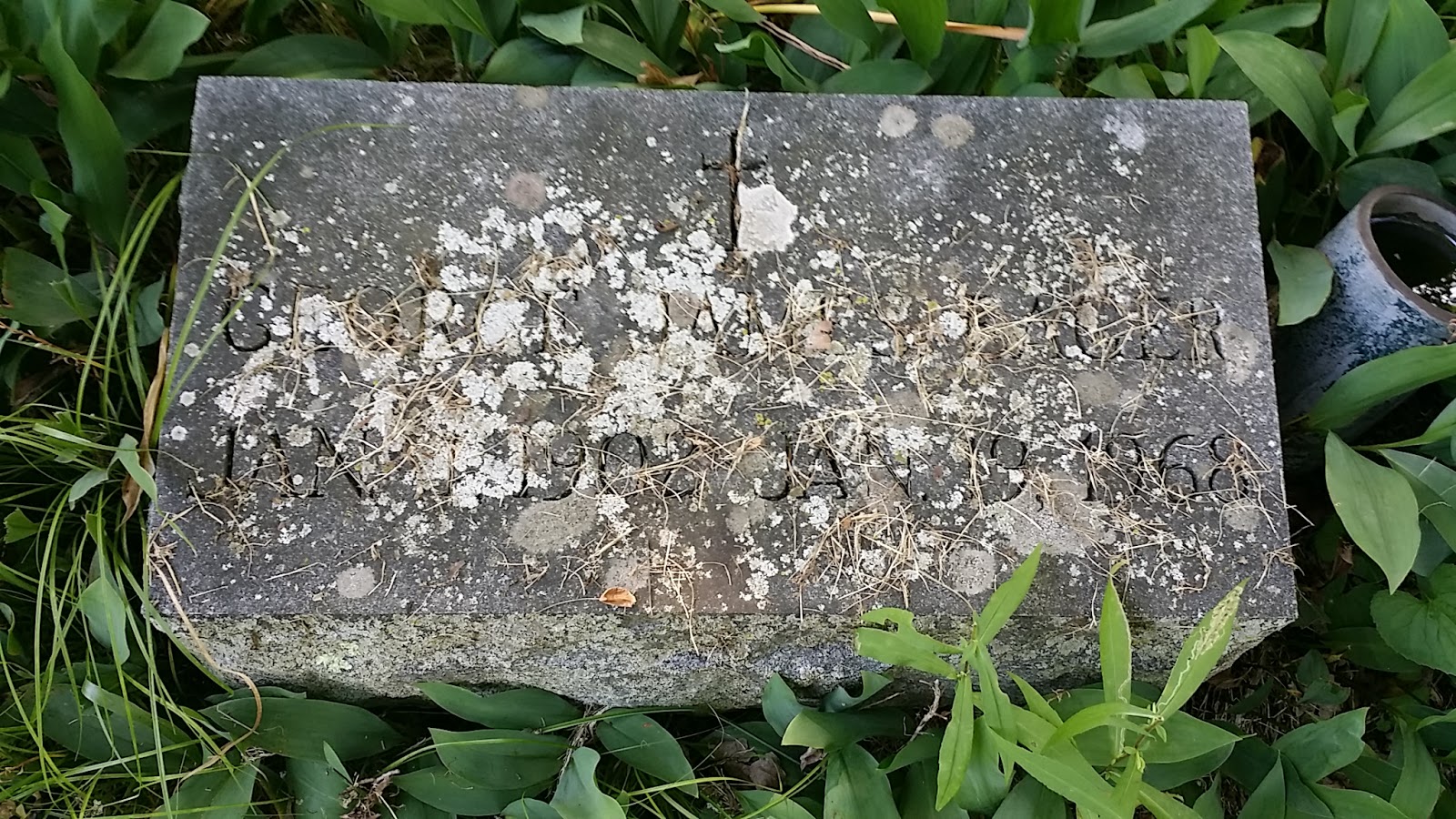
I must have touted the power of D2 Biological Solution a hundred times. But pictures say more words than I can. Below are a series of photos taken at the Nassau-Schodack Cemetery from early Summer through early Fall, last year.
The small granite gravestone is that of one of my great-granduncles, George James Eger. George was a younger brother of one of my great-grandmothers, Catherine Eger Gannon. Notice the name spelling. That is a story for another time. But quickly, George's wife thought the name was "too" ethnic and thus the name was changed.
D2 is the go-to solution for removing biological growth such as moss, lichens, mold, and mildew. It will not harm the stone as other household cleaning chemicals will. The photos below show what happens over time.
The small granite gravestone is that of one of my great-granduncles, George James Eger. George was a younger brother of one of my great-grandmothers, Catherine Eger Gannon. Notice the name spelling. That is a story for another time. But quickly, George's wife thought the name was "too" ethnic and thus the name was changed.
 |
| Water, D2, & a Soft Bristle Brush |
D2 is the go-to solution for removing biological growth such as moss, lichens, mold, and mildew. It will not harm the stone as other household cleaning chemicals will. The photos below show what happens over time.
 |
| June 2017, before cleaning |
 |
| June 2017, immediately after cleaning |
 |
| August 2017, beginning to brighten |
 |
| October 2017, four to five months later |
01 February 2018
Follow Up on Cleaning & Restoring Gravestones
This is a short follow-up on last week's post on cleaning and restoring gravestones. Last Sunday when the weather was mild and in the 40s I took a quick walk through a local cemetery and snapped these photos. The photos show various gravestones in different degrees of needed work.
What looks like almost nothing is wrong is the photo below. Notice how the stone is actually rising along with the growth of the offending cedar tree. The tree roots and trunk are actually raising the stone out of the ground. The only permanent fix for this is to remove the tree and then re level the grade and reset the stone. The stone work is minimal but the tree and root work can be extensive. This happens in most cemeteries. Ornamental shrubs and trees are planted but then not tended to for years and then the result is a large overgrown and unruly plant.

The next photo shows a perfect example of what I described as the iron pins that hold the stone upright on its base oxidizing. Over time, the pins rust and when they oxidize the pins expand and crack the stone. These pins must be removed, the stone repaired with Lithomex, and new stainless steel pins installed in place of the iron pins. Some times the stone will become rust colored where the pins are. It is as if the rust is bleeding through. This usually happens before the stone breaks.

The below photo shows a major causality. The stone is broken, is delaminating, and is also sugared. It appears that much of the face of the stone where the inscription was has completely flaked off. This type of work is to be left to a professional gravestone conservator. At the same time, it also could be a lost cause. The stone can be put back together but the inscription is gone. Who was this person?

The repair that was a great idea but done incorrectly is below. The side brackets would never last; especially with the angle of the leaning tablet.

Finally the next photo is the stone of a distant cousin. The stone is obviously in much need of repair but this should be a relatively easy repair if all of the pieces are present. I look forward to this work in the upcoming Spring. When a stone that is damaged as such is restored; it is a huge sense of accomplishment when it is put back together and standing upright as it did 100 plus years ago.

What looks like almost nothing is wrong is the photo below. Notice how the stone is actually rising along with the growth of the offending cedar tree. The tree roots and trunk are actually raising the stone out of the ground. The only permanent fix for this is to remove the tree and then re level the grade and reset the stone. The stone work is minimal but the tree and root work can be extensive. This happens in most cemeteries. Ornamental shrubs and trees are planted but then not tended to for years and then the result is a large overgrown and unruly plant.

The next photo shows a perfect example of what I described as the iron pins that hold the stone upright on its base oxidizing. Over time, the pins rust and when they oxidize the pins expand and crack the stone. These pins must be removed, the stone repaired with Lithomex, and new stainless steel pins installed in place of the iron pins. Some times the stone will become rust colored where the pins are. It is as if the rust is bleeding through. This usually happens before the stone breaks.

The below photo shows a major causality. The stone is broken, is delaminating, and is also sugared. It appears that much of the face of the stone where the inscription was has completely flaked off. This type of work is to be left to a professional gravestone conservator. At the same time, it also could be a lost cause. The stone can be put back together but the inscription is gone. Who was this person?

The repair that was a great idea but done incorrectly is below. The side brackets would never last; especially with the angle of the leaning tablet.

Finally the next photo is the stone of a distant cousin. The stone is obviously in much need of repair but this should be a relatively easy repair if all of the pieces are present. I look forward to this work in the upcoming Spring. When a stone that is damaged as such is restored; it is a huge sense of accomplishment when it is put back together and standing upright as it did 100 plus years ago.

23 January 2018
Cleaning &/or Restoring Gravestones
So... you want to clean gravestones and or rehab them. My question to you is... are you crazy? OK, just kidding, it is very rewarding, but do you know what is involved, what to do, what not to do, and more importantly do you know or realize your limitations? These are questions that need to be asked in order to accomplish your task safely for both yourself and for the gravestone. It seems easy, just grab some water, yes; some brushes, perhaps if you have the correct brush; household cleaners, and get to work; no, no, no! Did I already say no?

For starters, the go-to chemical for cleaning gravestones is D2 Biological Solution. It is sold locally in the Albany area; in either one gallon or five gallon containers. It is expensive but it is the only approved chemical for cleaning biological growth off gravestones. Biological growth is moss, mold, or various lichens. Biological growth is not dirt. Dirt may or may not be removed with the use of D2. For actually cleaning a gravestone Orvus soap has been used by other conservators. I have no experience with using Orvus on gravestones. So I cannot speak on cleaning techniques with Orvus.

Before I decide to clean a gravestone the first thing that I do is look the stone over and ask myself the following questions. Does the stone really need to be cleaned? I do not simply clean every gravestone that is discolored. Only ones that are illegible and those that require repair are what I clean with D2. Is the gravestone damaged? If it is broken, can I easily handle it? During the inspection ask yourself this question, will I damage the stone more than it already is if I attempt a cleaning? If the answer is yes, leave it alone. Do not mess with it. Leave it to the pros. Most important, if I start working on this stone will it fall and possibly on me? If the stone is large always position your body away or on the side of the stone so that if it does fall it will not land on you.
Regarding damaged gravestones, the photo below shows what is known as delamination. Delamination occurs when weathering opens and a weak spot forms where the the outer layer of the stone begins to separate and flake off in layers. Do not attempt a repair on this unless you are a professional.
Cleaning with Clorax is a huge no no. Clorax will damage the stone because it is a caustic chemical. Salts within the Clorax will soak into the porous stone, especially marble, and begin to eat away at the stone. This reaction will cause damage known as sugaring. Below is an example of sugaring.
Moss, lichens, and other plant growth that enter small cracks in the stone will also eventually cause more damage with the roots digging further into stone which will allow for water to enter the opening and begin a freeze thaw process that can break the stone at the crack.
When repairing a broken stone; in the below picture, the stone is a tablet grave marker from a local cemetery. Notice the incorrect side bracing and what do you think the end result was.

The cleaning process that I use follows as such.
Gravestones, especially marble stones can be found in cemeteries in three different manners. First, many of tablet style gravestones are larger than you think. The photo below shows Mary Cline's gravestone. Her stone is almost five feet long with the majority of the stone buried in the ground for stability. Her stone was excavated, straightened, and back filled with compacted stone dust. Over the period of years her stone began to lean due to gravity and conditions of the soil.

Next to Mary's stone is her husband, Russell. His marble stone is attached to a marble base via pins and mortar. The photo below shows another plot that was in need of attention. The pins and pin holes are clearly visible in the photo.
Iron pins held the marker to the base and mortar was applied under the stone and around the joint where the stone meets the base. Over time the mortar fails and seems to vanish.
The iron pins are removed because they tend to rust and oxidize which causes the pin to expand and this can cause the stone to break. Have you ever notices rust like discoloring and upward cracks on the stone just above the base. That is from oxidation. The iron pins are replaced with stainless rod that is cut to length and secured with a special type of lime mortar called Lithomex. The Lithomex is placed under the stone and also pointed around the joint where the stone meets the base to seal the joint.
Lithomex is porous and allows the stone to "breathe." Never repair gravestones with Portland cement. Repairs with Portland cemetery can further damage the stone because Portland is much harder and stronger than marble and lime gravestones which will cause the gravestone to break and not the Portland. When a stone is repaired with lime based Lithomex the repair will break if needed and not the stone itself.
The third way that marble stones are found in cemeteries is in the mortise and tenon or tab and socket method. This is where either a small "tab" in the center of the stone fits into a slot in the center of the base or the whole tablet fits into a large slot in the base. Below is a photo of a base where the tablet fits into the slot.

This large stone below did not have a base. For some reason the base was gone and only way to keep the stone upright was to fabricate a new base. Making a new base is relatively easy. Cement, 2 x 6s, screws, and insulating foam is all that I use. The foam is cut to custom width and depth according to the size of the stone. When the base is cured the foam is removed and you have a slot where the stone can be inserted. The slot is slightly larger than the stone and is partially filled with the lime based mortar. After the stone is inserted the joint is sealed with additional Lithomex.
Putting broken gravestones back together can be a process, especially if much of the stone is missing. The epoxy that I use is Akemi Akepox 2030. It is a two part epoxy that is very strong. Not much is needed to make repairs. Just dab along the break line, secure with clamps, and then infill with Lithomex to fill and hide the crack.
Finally, gravestones are heavy. Some are light enough that they can be picked up and set in place by hand and some cannot. Therefore mechanical means are necessary to safely lift a stone in place. Below is an example of a stone that was too heavy to lift; so the tripod, hoist, and soft nylon straps were brought in to safely make needed.

As a final note, when attempting this work, be safe, do the right thing, have fun, and enjoy!
For further information on cleaning or restoring gravestones, please see:
Online Sources
Association for Gravestone Studies
Cemetery Conservators for United Standards
Chicora.org
Iscga.org
Print Sources
Strangstad, Lynette. A Graveyard Preservation Primer. New York: Altamira Press, 2013
Jones, Melanie S. Aspects of Stone Weathering, Decay and Conservation. London: Imperial College Press, 1997

For starters, the go-to chemical for cleaning gravestones is D2 Biological Solution. It is sold locally in the Albany area; in either one gallon or five gallon containers. It is expensive but it is the only approved chemical for cleaning biological growth off gravestones. Biological growth is moss, mold, or various lichens. Biological growth is not dirt. Dirt may or may not be removed with the use of D2. For actually cleaning a gravestone Orvus soap has been used by other conservators. I have no experience with using Orvus on gravestones. So I cannot speak on cleaning techniques with Orvus.

Before I decide to clean a gravestone the first thing that I do is look the stone over and ask myself the following questions. Does the stone really need to be cleaned? I do not simply clean every gravestone that is discolored. Only ones that are illegible and those that require repair are what I clean with D2. Is the gravestone damaged? If it is broken, can I easily handle it? During the inspection ask yourself this question, will I damage the stone more than it already is if I attempt a cleaning? If the answer is yes, leave it alone. Do not mess with it. Leave it to the pros. Most important, if I start working on this stone will it fall and possibly on me? If the stone is large always position your body away or on the side of the stone so that if it does fall it will not land on you.
Regarding damaged gravestones, the photo below shows what is known as delamination. Delamination occurs when weathering opens and a weak spot forms where the the outer layer of the stone begins to separate and flake off in layers. Do not attempt a repair on this unless you are a professional.
 |
| Photo courtesy gravestonematters.org.uk |
Cleaning with Clorax is a huge no no. Clorax will damage the stone because it is a caustic chemical. Salts within the Clorax will soak into the porous stone, especially marble, and begin to eat away at the stone. This reaction will cause damage known as sugaring. Below is an example of sugaring.
 |
| Photo courtesy Internet search |
Moss, lichens, and other plant growth that enter small cracks in the stone will also eventually cause more damage with the roots digging further into stone which will allow for water to enter the opening and begin a freeze thaw process that can break the stone at the crack.
 |
| Photo courtesy chicora.org |
When repairing a broken stone; in the below picture, the stone is a tablet grave marker from a local cemetery. Notice the incorrect side bracing and what do you think the end result was.

The cleaning process that I use follows as such.
- the stone is first checked for stability and damage (we do not want to incur further damage to the stone)
- if the stone has heavy lichen growth, I begin by gently scraping the growth off with a soft scraper or popsicle stick (we want the stick to wear down and not the stone)
- next the stone is gently scrubbed with water and a soft nylon bristle brush to further remove biological growth
- the stone is then rinsed with clean water from a pump garden sprayer
- D2, poured into a spray bottle is then sprayed on all faces of the stone and allowed to remain on the stone for 15 minutes
- after 15 minutes, with fresh water the stone is again scrubbed with the soft nylon bristle brush
- more D2 may need to be applied and scrubbed in
- the stone is given a final rinse with the pump sprayer
- the stone will definitely be cleaner, but within 3 months time the stone should be noticeably brighter. One thing to remember is that all gravestones are not created equal. Some clean up better than others. Sad but true.
Gravestones, especially marble stones can be found in cemeteries in three different manners. First, many of tablet style gravestones are larger than you think. The photo below shows Mary Cline's gravestone. Her stone is almost five feet long with the majority of the stone buried in the ground for stability. Her stone was excavated, straightened, and back filled with compacted stone dust. Over the period of years her stone began to lean due to gravity and conditions of the soil.

Next to Mary's stone is her husband, Russell. His marble stone is attached to a marble base via pins and mortar. The photo below shows another plot that was in need of attention. The pins and pin holes are clearly visible in the photo.
 |
| All three stones in need of restoration Notice the securing pin & pin holes |
Iron pins held the marker to the base and mortar was applied under the stone and around the joint where the stone meets the base. Over time the mortar fails and seems to vanish.
The iron pins are removed because they tend to rust and oxidize which causes the pin to expand and this can cause the stone to break. Have you ever notices rust like discoloring and upward cracks on the stone just above the base. That is from oxidation. The iron pins are replaced with stainless rod that is cut to length and secured with a special type of lime mortar called Lithomex. The Lithomex is placed under the stone and also pointed around the joint where the stone meets the base to seal the joint.
 |
| Notice the Lithomex seal around the base of the stone |
Lithomex is porous and allows the stone to "breathe." Never repair gravestones with Portland cement. Repairs with Portland cemetery can further damage the stone because Portland is much harder and stronger than marble and lime gravestones which will cause the gravestone to break and not the Portland. When a stone is repaired with lime based Lithomex the repair will break if needed and not the stone itself.
The third way that marble stones are found in cemeteries is in the mortise and tenon or tab and socket method. This is where either a small "tab" in the center of the stone fits into a slot in the center of the base or the whole tablet fits into a large slot in the base. Below is a photo of a base where the tablet fits into the slot.

This large stone below did not have a base. For some reason the base was gone and only way to keep the stone upright was to fabricate a new base. Making a new base is relatively easy. Cement, 2 x 6s, screws, and insulating foam is all that I use. The foam is cut to custom width and depth according to the size of the stone. When the base is cured the foam is removed and you have a slot where the stone can be inserted. The slot is slightly larger than the stone and is partially filled with the lime based mortar. After the stone is inserted the joint is sealed with additional Lithomex.
 |
| Fabricated new base |

Putting broken gravestones back together can be a process, especially if much of the stone is missing. The epoxy that I use is Akemi Akepox 2030. It is a two part epoxy that is very strong. Not much is needed to make repairs. Just dab along the break line, secure with clamps, and then infill with Lithomex to fill and hide the crack.
 |
| Original condition Gravesite of my great great grandfather's sister |
 |
| Initial cleaning and epoxying |
 |
| Broken stone attached to base |
 |
| More expoxying and clamping |
 |
| Before final crack infilling |
Finally, gravestones are heavy. Some are light enough that they can be picked up and set in place by hand and some cannot. Therefore mechanical means are necessary to safely lift a stone in place. Below is an example of a stone that was too heavy to lift; so the tripod, hoist, and soft nylon straps were brought in to safely make needed.

As a final note, when attempting this work, be safe, do the right thing, have fun, and enjoy!
For further information on cleaning or restoring gravestones, please see:
Online Sources
Association for Gravestone Studies
Cemetery Conservators for United Standards
Chicora.org
Iscga.org
Print Sources
Strangstad, Lynette. A Graveyard Preservation Primer. New York: Altamira Press, 2013
Jones, Melanie S. Aspects of Stone Weathering, Decay and Conservation. London: Imperial College Press, 1997
14 December 2017
Tombstone Tuesday Post on Thursday
This article was meant to post on Tuesday but I was caught up in other activities. Last week before Winter actually set in I took a ride to the cemetery of the Lisha Kill Reformed Church in Colonie. I was looking for a distant cousin's gravestone to snap a photo of it. This cemetery is tiny and of course I will have to go back in the Spring to locate it because I could not find it.
However, the cemetery is very old with many older style grave markers, many of them are extremely difficult to read. As I was passing through I noticed the heavy moss growth that was growing on a particular stone. I stopped and used my finger to gently scrape the moss off. I stopped what I was doing to snap a photo of the offending moss and then proceeded to remove the rest of the moss and then take another photo. All for a future blog post. This one.
This was done because I read in various posts on other sites how some people think that a gravestone should not be cleaned ever and if you do clean a stone you are removing history and patina from the stone. Well I never heard of a gravestone having a patina such as perhaps a copper weather vane for example.
Over the years gravestones accumulate dirt, moss, lichens, and the effects of acid rain. I clean gravestones however I do not simply clean them just to clean them. My cleaning process is done so that further repairs can be made to a stone. For example if you were going to re-silicon the tile around your bathtub you would make sure that everything was clean because if you did not your work would quickly fail because your silicon would not "stick." Same with a gravestone. The stone and its base must be clean before any kind of lime based mortar can be used to seal the bottom of the stone to the base and to secure it and to keep water from migrating under the stone. I will also clean a stone if the inscription is completely unreadable. My processes for cleaning gravestones are all approved by various restoration associations, foremost being the Association for Gravestone Studies.
Back to the moss. The photos will show the moss growing inside the fizzer cracks that have appeared on the sides of the stone. Believe it or not the moss growth growing inside of the cracks and do damage to the stone just like water entering the stone and then freezing and further separating and damaging the stone.

Since it took me about 5 seconds to scrape the moss off and nothing further done to the stone. The moss will be back again next year as if I never did anything. The approved chemical for cleaning gravestones is D2 Biological Solution. D2 sprayed on the remnants of the moss and left on the stone for 10 to 15 minutes and then gently scrubbed clean with a soft bristle brush and clean water would kill all of the biological growth on the stone including moss and all lichens.

But then what remains is the fizzer cracks. They should be infilled with a lime based mortar of the appropriate color to keep anything else from entering the cracks especially water.
However, the cemetery is very old with many older style grave markers, many of them are extremely difficult to read. As I was passing through I noticed the heavy moss growth that was growing on a particular stone. I stopped and used my finger to gently scrape the moss off. I stopped what I was doing to snap a photo of the offending moss and then proceeded to remove the rest of the moss and then take another photo. All for a future blog post. This one.
This was done because I read in various posts on other sites how some people think that a gravestone should not be cleaned ever and if you do clean a stone you are removing history and patina from the stone. Well I never heard of a gravestone having a patina such as perhaps a copper weather vane for example.
Over the years gravestones accumulate dirt, moss, lichens, and the effects of acid rain. I clean gravestones however I do not simply clean them just to clean them. My cleaning process is done so that further repairs can be made to a stone. For example if you were going to re-silicon the tile around your bathtub you would make sure that everything was clean because if you did not your work would quickly fail because your silicon would not "stick." Same with a gravestone. The stone and its base must be clean before any kind of lime based mortar can be used to seal the bottom of the stone to the base and to secure it and to keep water from migrating under the stone. I will also clean a stone if the inscription is completely unreadable. My processes for cleaning gravestones are all approved by various restoration associations, foremost being the Association for Gravestone Studies.
Back to the moss. The photos will show the moss growing inside the fizzer cracks that have appeared on the sides of the stone. Believe it or not the moss growth growing inside of the cracks and do damage to the stone just like water entering the stone and then freezing and further separating and damaging the stone.

Since it took me about 5 seconds to scrape the moss off and nothing further done to the stone. The moss will be back again next year as if I never did anything. The approved chemical for cleaning gravestones is D2 Biological Solution. D2 sprayed on the remnants of the moss and left on the stone for 10 to 15 minutes and then gently scrubbed clean with a soft bristle brush and clean water would kill all of the biological growth on the stone including moss and all lichens.

But then what remains is the fizzer cracks. They should be infilled with a lime based mortar of the appropriate color to keep anything else from entering the cracks especially water.
21 November 2017
Tombstone Tuesday : Johann Remigius (Michael) Albert
Ah, it is eight days since my shoulder operation. My bicep tendon in shoulder was torn and revamped. The rotator cuff tendon was partially torn and repaired. The lambrum which holds your shoulder in place was damaged and tightened. The reason this is being mentioned is because I am right handed. It was my right shoulder that was repaired. Now I find it very difficult to manage with one "left" arm. Typing up until now was literally impossible. I managed to rig myself and arm so that I can type; but not for long. Therefore unless posts are already scheduled to go live, articles may be scarce for a bit. We will see.
The second to last gravestone that I repaired before my operation was that of Johann Remigius (Michael) Albert and that of his wife Theresa Maier Albert. The stone had tipped over due to the base being unlevel and an offending shrub obscuring the stone. Below shows the shrub removed but the base is un-level.

Next the base was leveled. The stone was hoisted upright to be cleaned, two new pins installed, and fresh lithomex mortar layed underneath the stone and around the joint where the stone meets the base. No comment on the shoe.

The final product is below. Over the Winter the D2 should do its work and the stone will be brighter come this Spring.

Until the Spring comes, my gravestone restoration projects are finished. Injuries, Winter, snow, cold, and ice will make sure that I now take up my genealogy research for a while.
The second to last gravestone that I repaired before my operation was that of Johann Remigius (Michael) Albert and that of his wife Theresa Maier Albert. The stone had tipped over due to the base being unlevel and an offending shrub obscuring the stone. Below shows the shrub removed but the base is un-level.

Next the base was leveled. The stone was hoisted upright to be cleaned, two new pins installed, and fresh lithomex mortar layed underneath the stone and around the joint where the stone meets the base. No comment on the shoe.

The final product is below. Over the Winter the D2 should do its work and the stone will be brighter come this Spring.

Until the Spring comes, my gravestone restoration projects are finished. Injuries, Winter, snow, cold, and ice will make sure that I now take up my genealogy research for a while.
21 July 2017
Cemetery Articles in the Rensselaer County Advertiser
Just checked the mail and received the weekly Rensselaer County Advertiser newspaper and found two articles regarding cemeteries. One good, one bad. The good article posts:
Castleton Public Library Events
Castleton Public Library Events
- Cemetery Headstone Cleaning, Tuesday, 25 July, 12 - 1 pm, Meet at flagpole at Mountain View Cemetery (Scott Avenue). An adult must accompany kids under 11.
Castleton Public Library
85 South Main Street, Castleton, NY 12033
518.732.0879
www.castletonpubliclibrary.org
Now, the unhappy article which is a letter to the Editor. It reads:
A Plea to Have Stolen Cemetery Floral Piece Returned
Recently for Mom's Day, I bought a beautiful cemetery floral piece for my parent's headstone at Bloomingrove Cemetery. Because I don't have my parents any longer, I still like to remeber them on Mother's Day and Father's Day. I placed the floral arrangement (an artificial one) on the headstone on Mother's Day.
I Went to the cemetery on Father's Day to pay my respect to my Dad. The arrangement was gone! I know it didn't blow away, because it fit rather securely to the headstone.
Anyone who would take a floral piece from a grave site is dspicable! If they wanted it for someone they knew who had died, they are not honoring them by putting a stolen arrangement on their grave site.
I won't replace it to be stolen again. At least I know I did the right thing. My conscience is clear. I'm sure whoever took it doesn't have a conscience. If you have any sense of right and wrong, you will put it back where it belongs.
Xx Xx, Rensselaer
26 June 2017
New Mount Ida Cemetery,Troy, Looking for Volunteers
A friend, Alysia, passed this note on to me. The group that is restoring the New Mount Ida Cemetery on Pinewoods Avenue in Troy is looking for help/volunteers with gravestone restoration in July. Details are below:
We are looking for volunteers again for our annual stone repair workshop in the New Mount Ida Cemetery, on Pinewoods Avenue in Troy. It will be held Saturday, July 8th and Sunday, July 9th from 8am-5pm. Joe Ferrannini will be here again for our annual event, and we are looking for help with cleaning stones with soft brushes. Joe will be doing the actual repair work on the markers. Its always very rewarding and always a great time to hang out with other volunteers. Plus its so great to see the stones once they are all repaired. Please feel free to pass this along to anyone that you know of that may be interested!
We are looking for volunteers again for our annual stone repair workshop in the New Mount Ida Cemetery, on Pinewoods Avenue in Troy. It will be held Saturday, July 8th and Sunday, July 9th from 8am-5pm. Joe Ferrannini will be here again for our annual event, and we are looking for help with cleaning stones with soft brushes. Joe will be doing the actual repair work on the markers. Its always very rewarding and always a great time to hang out with other volunteers. Plus its so great to see the stones once they are all repaired. Please feel free to pass this along to anyone that you know of that may be interested!
03 December 2015
Evangelical Protestant Cemetery Restoration Project in Albany
It is believed that the oldest visible cemetery within the city limits of Albany is the Evangelical Protestant Cemetery located on Krumkill Road. The cemetery was established in 1854. Lately, has anyone noticed the condition of the cemetery? Well, the cemetery is being invaded by encroaching scrub brush and sapling trees. This growth is overtaking the cemetery plots that boarder its perimeter. Many of these grave sites are those of Civil War veterans.
Inside the cemetery, numerous stones have toppled over due to a variety of causes. The longer the cemetery is in this condition; the harder it will be to bring it back. More importantly the grave stones, if left as they are, will incur further damage.
A new blog and an accompanying video were created to exploit the plight of the cemetery. Its pictures and video speak loudly. The blog is Friends of the Evangelical Protestant Cemetery, Albany, NY
Anyone who is interested in preserving a part of our local history should visit the blog and perhaps contact the "friends" if they are interested in helping with this worthy cause.
Inside the cemetery, numerous stones have toppled over due to a variety of causes. The longer the cemetery is in this condition; the harder it will be to bring it back. More importantly the grave stones, if left as they are, will incur further damage.
A new blog and an accompanying video were created to exploit the plight of the cemetery. Its pictures and video speak loudly. The blog is Friends of the Evangelical Protestant Cemetery, Albany, NY
Anyone who is interested in preserving a part of our local history should visit the blog and perhaps contact the "friends" if they are interested in helping with this worthy cause.
15 September 2015
Cemetery Restoration Project at New Mount Ida Cemetery
Coming up this weekend is a cemetery restoration project at the New Mount Ida Cemetery on Pinewoods Avenue in Troy. The dates are Saturday and Sunday, September 19th and 20th beginning around 8 AM.
The focus of this project will be to restore the grave sites of Civil War veterans who are buried at New Mount Ida. This venture is being undertaken in the name and memory of Ed Dodge. Ed was a fellow cemetery enthusiast who passed away recently. Mr. Dodge was implemental in getting grave stone replacements for missing and damaged grave markers for veterans at the old Lansingburgh burial grounds.
Joe Ferrannini from Grave Stone Matters will be there lending his expertise at preserving and conserving gravestones. Please stop by to lend a hand at restoring the graves of our veterans.
The focus of this project will be to restore the grave sites of Civil War veterans who are buried at New Mount Ida. This venture is being undertaken in the name and memory of Ed Dodge. Ed was a fellow cemetery enthusiast who passed away recently. Mr. Dodge was implemental in getting grave stone replacements for missing and damaged grave markers for veterans at the old Lansingburgh burial grounds.
Joe Ferrannini from Grave Stone Matters will be there lending his expertise at preserving and conserving gravestones. Please stop by to lend a hand at restoring the graves of our veterans.
15 August 2015
Joseph Wagner & Maria Koreman, bio & gravesite restoration
 |
| Spring-time photo of grave site |
Seeing this I knew that I had an additional cemetery job to handle. So that nothing would hopefully happen to the stones before I could get to rehabbing them, I leaned the stones against the only upright stone and placed a flag in the ground with them. The flag was mysteriously gone when the rehab began. Joseph Wagner was mustered in the 7th Heavy Artillery during the Civil War. Below is a picture of the grave site in April. Finally work began on the site on Thursday, August 13th.

While I was waiting for the weather to warm up; some research on Joseph & Maria was conducted. Both, Joseph & Maria, were immigrants. Joseph was born 03 September 1845 in Frankfort, Prussia. He immigrated to America circa 1859 with his siblings and parents, Conrad & Barbara Wagner. Maria was born Maria Allegonda Koreman on 16 March 1838 in Zierikzee, Netherlands. Below is a scan of Maria's birth certificate from Zierikzee.
 |
| Maria Allegonda Koreman, birth certificate |
Maria immigrated to the United States with her siblings and parents Cornelis Koreman and Maria Catharina Colen circa 1852. Joseph and Maria were married at Holy Cross Church in Albany on 04 May 1869. They had the following children:
- Mary A., born 15 May 1870
- Margaret A., born 17 November 1872, married Charles Aloyisus Beck
- Barbara, born 20 April 1875
- Joseph, born 03 November 1877
- Anna B., born 29 May 1880
- John Joseph, born 12 August 1884
Joseph and Maria lived for many years at 8 Osborn Street in Albany's South End. Brother, Henry Koreman lived up the street at house number 16 for over thirty years. Below is a photo of 8 Osborn Street today. Fortunately the house is still standing. I am not sure if the house is original or the facade has changed over the years. This is questioned because this style home does not fit the architectural style of the surrounding homes.


Below is a photo of a trunk key and name tag listing Joseph Wagner as living at 8 Osborn Street.

As mentioned earlier, Joseph was mustered in the 7th Heavy Artillery and before being mustered out was seriously injured. According to his pension records, his left arm above his elbow had a scar that was five inches long and three inches wide and that "all of the muscles were shattered." Perhaps he was hit with grapeshot? Below is a scan of Maria's Declaration for Widow's Pension.

Joseph died 03 August 1904 and on 08 July 1908 Maria followed him. Both buried in Glenmont. Below is a series of photos of the grave site rehab project which occurred over a three day period. Getting set up; the area looks like a construction site.

Photo below of the condition of the site before beginning work.

The first stone worked on was Maria's. Her stone was broken in three pieces and also broken at its base. First step was to clean all of the pieces with D2 to get them ready for epoxying them together.

Next, the upper two pieces of her stone were epoxied together using a conservator's professional grade epoxy from a German company, Akemi. The two stones were then clamped together overnight.

After putting the top two pieces of grave stone together, my next step was to re drill the lower stone and its base so that the marble could be re pinned for better stability, Below is the final product after cleaning, re pinning and motaring the base with a lime based mortar, Lithomex.

Next, the stone to the right, son, John J. Wagner's was lifted and its base leveled. Had the stone been left leaning forward, in time the marble where the pins are located would have broken due to stress on the stone. This adverted a future stone failure.
Joseph's stone was worked on next. His stone's base was re leveled and there was already a repair made to his stone sometime in the past. All of the Portland cement that was on the base was chipped off to make for a smooth surface to reattach the stone and base. Both the stone and base were re pinned and mortared with Lithomex.

The next day, on Friday, I came back to check on the top two pieces that were epoxied. Unfortunately the break occurred right where Maria's dates are located on the stone. They are practically unreadable. Also there was not much surface area to bond the stones together. Therefore the upper stone was re pinned with the lower section and epoxy was placed where the sections met. The stone also has a lot of missing surface area that needs to be fabricated. Below is a photo of the stone with the top section on the lower before the clamp was placed.

Below is the stone, re pinned, epoxied, and clamped. The next day the clamp will be removed and Lithomex will be used to fill in the seams and where the stone is missing and also to help stabilize the top portion of the stone to the lower.

The below photos are the final product of efforts at restoring Maria Koreman Wagner's grave stone and that of her husband, Joseph Wagner, and her son, John J. Wagner. When dry the Lithomex filler should fade to more closely match the actual stone color making the seam less noticeable.

The Wagner plot restored, below, Saturday evening, 15 August 2015.

Subscribe to:
Posts (Atom)